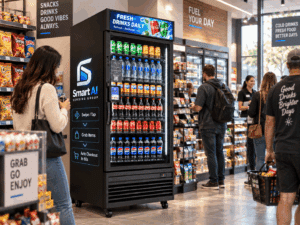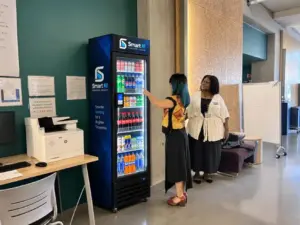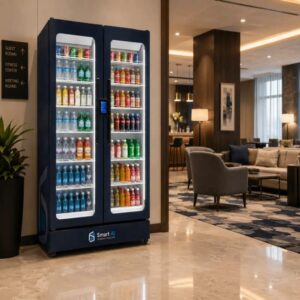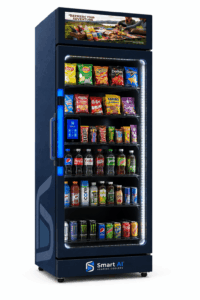

Micro market vs vending machine comes down to scale and trust. A vending machine, smart or traditional, is a single secure cabinet that suits smaller teams and limited space. A micro market is a small self-service shop with open shelves, fridges and a payment kiosk, and it suits larger workplaces that want a wider range of food. Most sites choose based on headcount, available space and how controlled access to the area is.
This guide compares the two side by side so you can decide which is right for your office, factory, hospital or campus.
Key Takeaways
- Vending machines are compact, secure and quick to install.
- Micro markets offer a wider range, including fresh meals, but need more space.
- Smart AI vending machines sit in between, offering open-door shopping in one cabinet.
- Micro markets work best in secure, staff-only areas.
- Headcount, space and product range are the three deciding factors.
What Is a Micro Market?
A micro market is an unattended mini-shop. Products sit on open shelving and in glass-door fridges, and customers pay at a self-checkout kiosk by scanning barcodes and tapping a card, phone or staff account. Think of it as a small convenience store without a cashier. Our micro markets page explains the formats we offer.
What Is a Vending Machine?
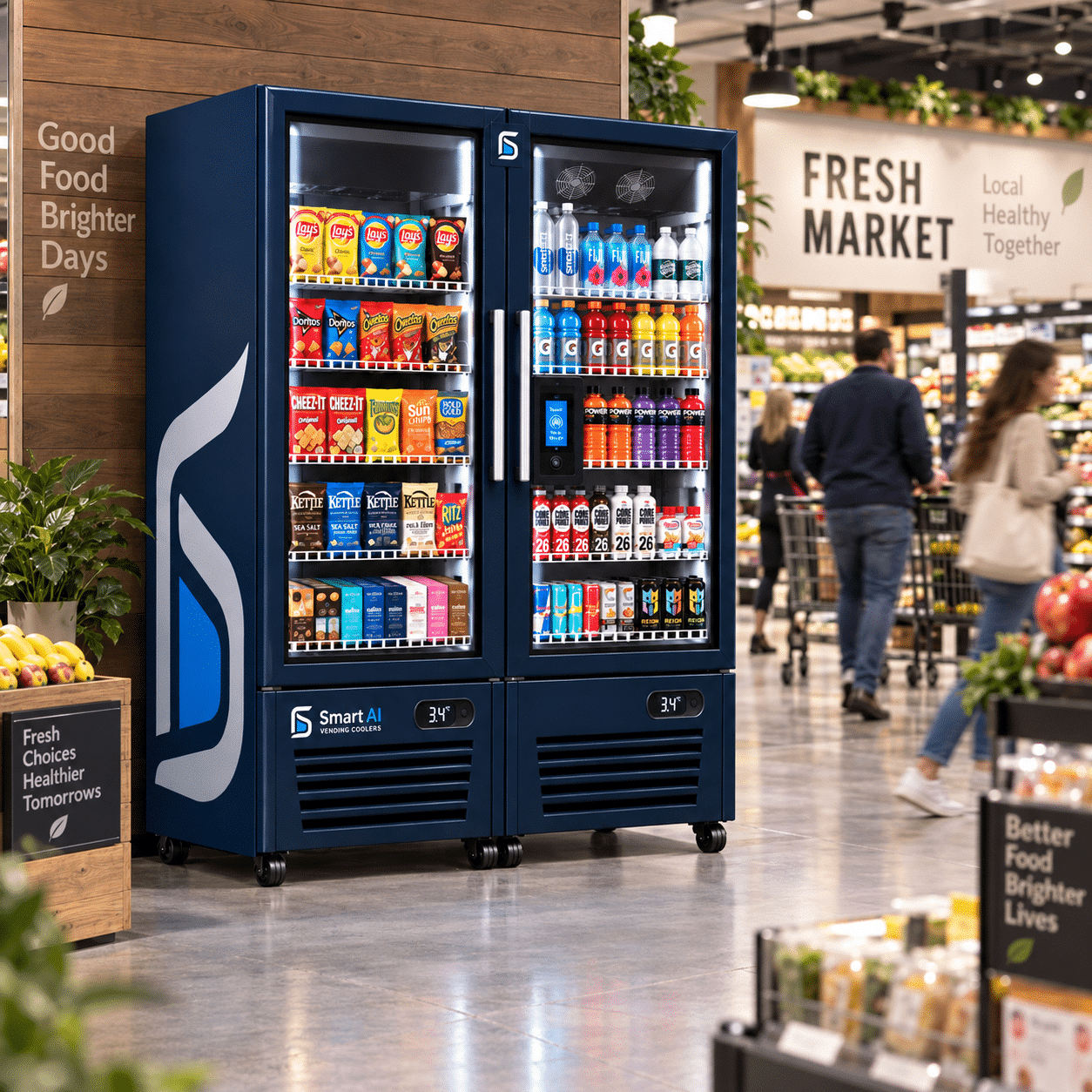
A vending machine is a single, locked cabinet. In a traditional machine, the customer selects a code and the item drops from a spiral. In a smart AI vending machine, the customer taps to unlock the door, takes items and is charged automatically, as explained in our guide on how smart vending machines work.
Micro Market vs Vending Machine: Side-by-Side Comparison
| Factor | Micro market | Vending machine (smart or traditional) |
|---|---|---|
| Footprint | A dedicated area with several units and a kiosk | One cabinet, typically against a wall |
| Product range | Wide: snacks, drinks, fresh meals, fruit, household items | Narrower, limited by cabinet capacity |
| Shopping experience | Browse open shelves like a shop | Select from one cabinet (open-door on smart models) |
| Payment | Self-checkout kiosk, card, phone or staff account | Card or phone at the machine (cash on some traditional ones) |
| Security | Relies on controlled access and CCTV | Locked cabinet; smart models unlock only after payment |
| Set-up | More planning, fixtures and space | Quicker to install |
| Best for | Larger, secure workplaces | Smaller teams, public areas or limited space |
When a Vending Machine Is the Better Choice
- Smaller teams: a single machine can serve a modest headcount without a full shop set-up.
- Limited space: a cabinet fits in a corridor, breakout area or reception.
- Public or semi-public areas: a locked cabinet is safer where access is not controlled.
- Quick deployment: fewer fixtures means a simpler installation.
- Focused range: drinks and snacks, or a specialist range like candy vending.
When a Micro Market Is the Better Choice
- Larger workforces: more people means more demand for variety.
- Fresh food focus: space for chilled meals, salads and fruit.
- Controlled access: staff-only canteens or break rooms with door entry and CCTV.
- Replacing a canteen: a micro market can offer an amenity where a staffed café is not viable.
- Shift work: around-the-clock access for night and weekend shifts.
The Middle Ground: Smart AI Vending Machines and Smart Stores
Smart AI vending machines blur the line. They keep the security of a locked cabinet but let people open the door, browse and take several items, so they feel closer to a shop. Several cabinets together can form a compact smart store, giving more variety without an open-shelf micro market. This is often the right step for growing sites that are not yet ready for a full micro market.
| Traditional vending | Smart AI vending | Micro market | |
|---|---|---|---|
| Range | Narrow | Medium | Wide |
| Space | Small | Small to medium | Large |
| Security | High | High | Depends on access control |
| Items per visit | One | Several | Many |
Cost Considerations
We will not quote generic prices, because costs vary widely with layout, range and equipment. In broad terms:
- a vending machine is a single piece of equipment, so upfront cost is easier to predict;
- a micro market involves several fridges, shelving, a kiosk and possibly fit-out work;
- both have ongoing software, payment and restocking costs;
- micro markets usually need more frequent restocking because of fresh food.
Our guide to smart vending machine cost breaks down each line you should expect on a quote.
Shrinkage and Security
Shrinkage means stock that is lost, damaged or taken without payment. Micro markets rely on honesty, controlled entry and camera coverage, so they suit trusted staff environments. Vending machines, including smart ones, only unlock after a valid card authorisation and record each transaction, which helps reduce losses in busier or more public spaces.
How to Decide: Five Questions to Ask
- How many people will use it each day, and across which shifts?
- How much floor space do you have, and is it secure?
- Do you need fresh meals or mainly drinks and snacks?
- Who will restock it, and how often?
- Do you want staff subsidies or account payments?
If your answers point to a large, secure space and a broad range, a micro market is likely to fit. If space is tight or access is open, a smart vending machine is usually the safer bet. You can find further guidance in our resources hub.
Real-World Scenarios
A 40-Person Office
Space is tight and the kitchen is shared with other tenants. A single smart vending cooler with drinks, snacks and a few chilled lunch options is likely to be enough, with secure access and no extra fit-out.
A 300-Person Distribution Centre
Shifts run around the clock, the nearest shop is a drive away and the break room is behind controlled entry. A micro market with fridges, open shelves and a kiosk could offer hot-meal options for a microwave, fresh fruit and household items alongside snacks.
A University Library
The building is open to students and visitors with varying supervision. Two smart vending machines in a well-lit lobby provide secure, 24-hour access without the shrinkage risk of open shelving.
Restocking and Operations Compared
| Task | Micro market | Vending machine |
|---|---|---|
| Restocking frequency | Often frequent, especially for fresh food | Based on sales; smart machines show live stock |
| Merchandising | Shelves need tidying and facing | Load cabinet to planogram |
| Date checks | Many lines to check | Fewer lines, easier to manage |
| Data and reporting | Kiosk sales reports | Machine-level sales and stock data |
Smart vending machines and micro market kiosks both produce sales data. Use it to see which products sell at which times, and adjust your range and restocking route accordingly. Over time, this is one of the most effective ways to reduce waste and improve availability.
Accessibility and User Experience
Whichever option you choose, think about everyone who will use it. Check reach heights, screen positions, clear pricing and allergen information for fresh food. Make sure payment options suit your users, and consider staff accounts or subsidies if you want to encourage healthier choices. A good experience keeps people coming back, which is what makes any unattended food option worthwhile.
Glossary of Unattended Retail Terms
If you are new to unattended retail, these terms come up often when comparing suppliers:
- Shrinkage: stock lost through theft, damage or errors
- Planogram: a map of where each product sits on a shelf or in a cabinet
- Self-checkout kiosk: a touchscreen terminal where customers scan and pay
- Telemetry: data sent from a machine about sales, stock and faults
- Pre-authorisation: a temporary card hold placed before a smart vending door unlocks
- Smart store: a group of smart cabinets offering a wider range in a compact space
Your Next Steps
If you are ready to move forward, these steps will help you go from research to a working installation with fewer surprises:
- Measure the space and note power and network points.
- Estimate daily users across every shift.
- List the products you want to offer, including any fresh food.
- Decide who will restock and how often.
- Request a site survey and itemised quote.
Our team can support you at each stage, from the first site survey to installation and aftercare. Browse our shop to see the machines we currently supply, or get in touch for tailored advice.
Frequently Asked Questions
Is a micro market cheaper than a vending machine?
Not usually upfront, because a micro market needs several fridges, shelving and a kiosk. The better question is which gives the best value for your headcount and range.
Can a micro market work in a public area?
Micro markets work best in controlled-access areas. In public spaces, a locked smart vending machine is generally more secure.
Can I start with vending and move to a micro market later?
Yes. Many sites start with one or two smart vending machines and expand as demand grows.
Do micro markets accept cash?
Most micro market kiosks are cashless, using cards, phone wallets or staff accounts.
Conclusion
In the micro market vs vending machine decision, there is no single winner. Vending machines are compact, secure and easy to deploy, while micro markets deliver choice at scale in trusted spaces. Smart AI vending sits neatly between the two. Talk to our team and we will help you match the format to your workplace.
Not Sure Which Format Fits?
Share your headcount, space and product plans and we will recommend a vending, smart store or micro market set-up.